You haven’t lost her. You just need a new language.

I am so glad you are here.

The complete toolkit to navigate the pre-teen years without the eye rolls, the silence, or the "interrogation" mode. 

Stop managing her schedule and start connecting with her heart.

THE PROBLEM
The silence is the hardest part.

There is a specific moment in motherhood that no one warns you about.

It’s the moment you realize the little girl who used to tell you _everything_—every detail of her dream, every drama on the playground—has started to hold things back.

You pick her up from school. You ask, "How was your day?"

And you get the one-word wall: "Fine." "Good." "Okay."

You try to dig deeper, but your questions feel like an interrogation. And for her, answering them feels like a performance. The air gets heavy. The radio gets turned up. The moment passes.

You aren’t doing anything wrong. And she isn’t pushing you away because she stopped loving you.


She is pushing away because she is transitioning. She is craving independence, but she is terrified of judgment. She needs you more than ever, but she doesn't know how to reach you across the gap.

It’s time to build a bridge.


THE SOLUTION

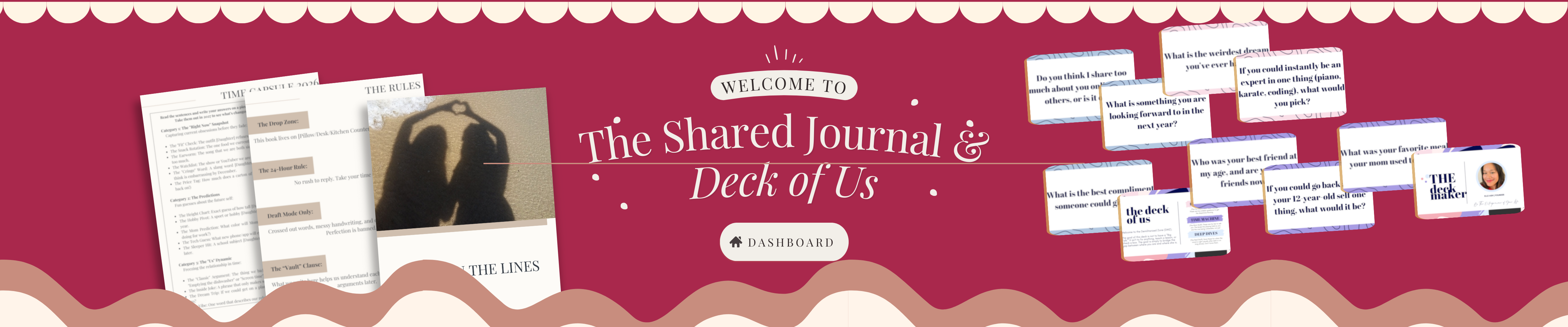
Introducing: The Connection Bundle
(A System for Safety, Play, and Repair)


This isn't just a journal or a card game. 

This is Relationship Architecture.

We are dismantling the pressure of "Face-to-Face" confrontation and replacing it with the safety of "Side-by-Side" connection. 


This bundle gives you the tools to lower the stakes, remove the awkwardness, and create a safe harbor for both of you.

🙋🏻‍♀️
How will it help you ?

You don’t need to be a "better" mom. You just need a new language.

Here is the truth about the pre-teen years: The tools that worked when she was seven—hugs, bedtime stories, and direct questions—often stop working when she turns twelve.

She isn't pushing you away; she is pushing for independence. But that process creates a gap. 


This bundle is designed to build a bridge across that gap, helping you navigate the three biggest hurdles of this season:

1. It Lowers the Stakes (Safety Over Performance)

Face-to-face conversation is high-pressure. She has to read your face, manage her tone, and formulate thoughts instantly. It’s exhausting for a developing brain.

How this helps: 

By moving heavy conversations to The Shared Journal, you remove the immediate "performance anxiety." She can write her truth without fear of being interrupted or seeing a look of disappointment on your face. You are giving her the one thing she wants most: Psychological Safety.
    

2. It Humanizes You (Connection Over Management)

Right now, you are "The Manager." You manage her schedule, her chores, her grades, and her screen time. It is hard to feel close to your boss.

How this helps:
 

The Deck of Us (specifically the "Time Machine" cards) flips the script. It forces you to share stories about your awkward middle school years. It reminds her that you weren't always "Mom"—you were a girl who felt insecure, silly, and scared, just like her. Connection happens when she sees your humanity, not just your authority.
    

3. It Turns "Interrogation" into Play


The car ride home is the danger zone. You ask questions because you care; she hears questions as an investigation.

How this helps: 

The cards disrupt this pattern. Instead of digging for information, you are playing a game. When you laugh together over a "Zombie Apocalypse Plan," you release dopamine in her brain that is associated with you. You are retraining her nervous system to see you as a source of joy, not just a source of rules.
    

The Bottom Line:

This bundle stops the drift. It ensures that even on the days when the door is slammed or the mood is heavy, you have a safe place to meet—whether it’s on the pages of a journal or over a silly card game in the driveway.


What You Get

This isn't just a notebook and a pack of cards. It is an intervention for the silence that creeps in between age 9 and 14.

When you purchase this bundle, you aren't just buying "things." You are buying a new way to speak to the daughter you feel like you are slowly losing to her phone, her friends, and her growing independence.

Here is the Relationship Architecture you are receiving:


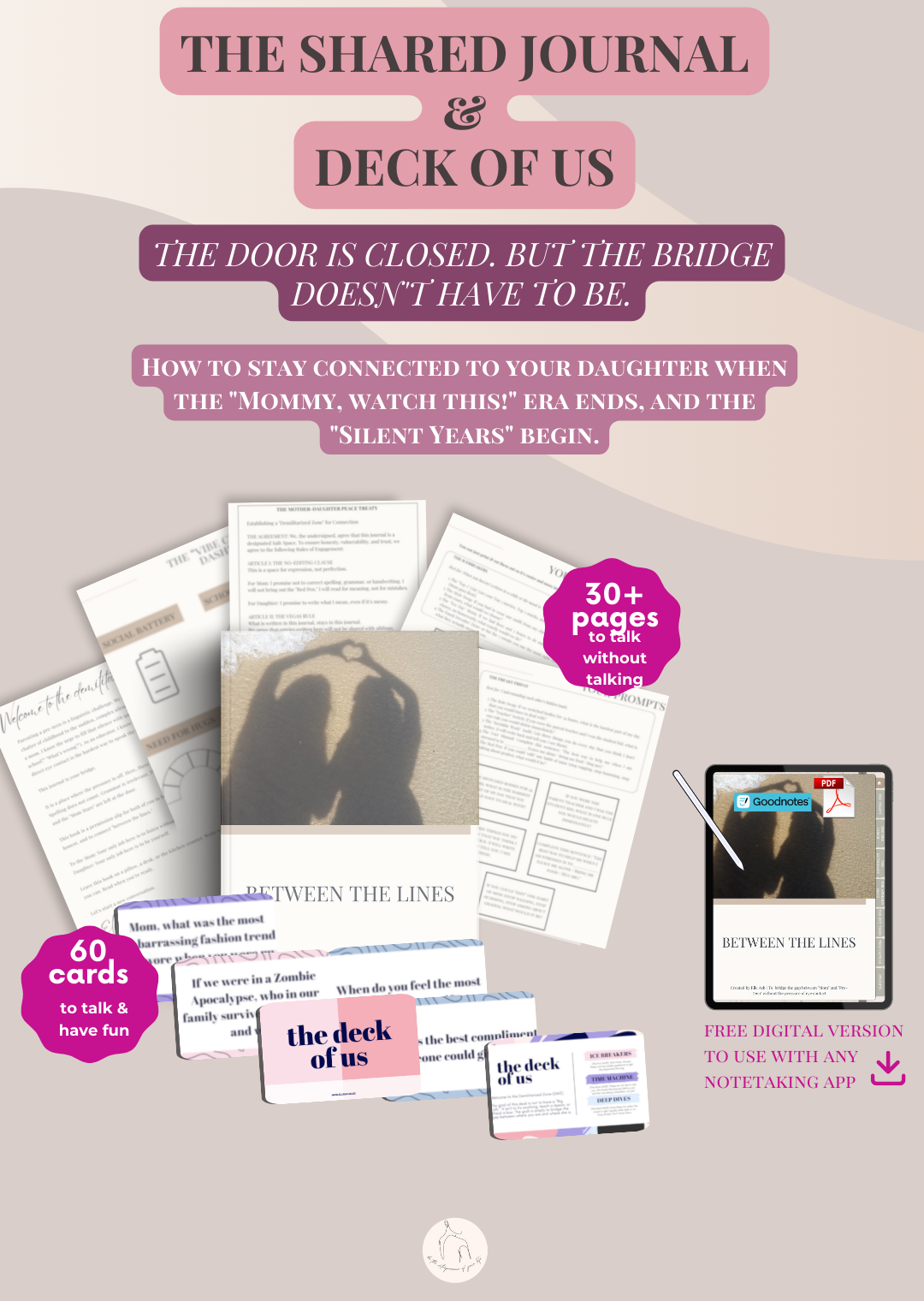
The Mother-Daughter Connection Suite
(A System for Safety, Play, and Repair)

You are getting a complete toolkit designed to dismantle the walls of the pre-teen years. We are replacing the friction of "face-to-face" confrontation with the safety of "side-by-side" connection.

Part 1: The Sanctuary (The Shared Journal)

For when the feelings are too big to speak out loud.

We take the pressure off the immediate conversation. By moving your communication to the page, you remove the reactive facial expressions, the interruptions, and the defensive tone.

The "Peace Treaty" Contract:

    
    You don't just start writing; you start by agreeing on safety. You will sign a contract establishing that what is written here, stays here. This is the foundation of trust she has been waiting for.
    
The "Vibe Check" Dashboard:
    
    Eliminate the guessing game. She uses a simple visual tool to circle her capacity (Green, Yellow, Red). You get the data you need to know when to lean in—and more importantly, when to back off—without ever nagging.
    
The "Repair Shop" Framework:
    
    Conflict is inevitable; rupture doesn't have to be permanent. You get guided templates to apologize and repair after a fight, teaching her that your relationship is strong enough to handle big emotions.
    

Part 2: The Playground (The Deck of Us)


For when the silence is too loud.

The car ride. The waiting room. The dinner table. These are the "danger zones" where you try to connect, but it feels like an interrogation. This deck changes the energy from "Mom is checking up on me" to "We are playing a game."

The "Time Machine" Cards:
    
    The Shift: These cards ask about your past.
        
    The Transformation: You stop being just "The Manager" of her life and become a human being who was once her age. You bond over your own embarrassing middle school stories.
        
The "Icebreaker" Cards:
    
    The Shift: Low-stakes, high-dopamine questions (e.g., Zombie Apocalypse Plans).
        
    The Transformation: You bypass the awkwardness and go straight to laughter. No "how was school?" allowed.
        

The Transformation

Before this Bundle:


You are roommates. You are managing her schedule, her laundry, and her homework, but you feel the emotional drift. You are walking on eggshells, afraid that one wrong question will shut her down.

After this Bundle:

You have a secret language.

You have a place where she can tell you the hard things without looking you in the eye.

You have a way to laugh in the car without forcing it.

You have built a bridge that will carry your relationship through the teenage years and out the other side.

Format:

The Shared Journal: Digital PDF (Printable or Tablet-Friendly).

The Deck of Us: Digital PDF (Print & Cut Format or Phone-Scrollable).


Hey there, if we haven't met yet, I'm Elle.


On paper, I am a University Lecturer and a steadfast mom to a pre-teen. I am the steady hand, the grader of papers, and the offerer of guidance. I am the one who holds the space for everyone else.


But in reality? I am a woman in the middle of a quiet identity crisis, learning how to finally hold space for herself.


I moved from the relentless hustle of Paris to the coast of Brittany, hoping the ocean would cure my burnout. But I learned the hard way that you can’t outrun exhaustion just by changing your zip code. The scenery changed, but the internal pressure stayed. I realized I was spending all my energy translating the world for my students and guiding my daughter through the shifting tides of adolescence, leaving no language left for myself.


So, I started reclaiming my creativity as a lifeline.


Whether it’s writing from the heart or designing digital products that bring beauty and order to the chaos, these aren't just "side projects." They are my daily practice of mental health, self-care, and personal evolution.


I created this space not because I have it all figured out, but because I am finally giving myself permission to ask: What’s next?


Whether you are an educator questioning your career path, a mom navigating the silence (and the storms) of the pre-teen years, or just someone trying to prioritize personal development—I hope my journey helps you feel a little less alone in yours.
FAQs

1. "What if my daughter rolls her eyes and refuses to do this?"

This is the #1 fear, and it’s valid. That is exactly why we included The Deck of Us.

If the Journal feels too "heavy" or "emotional" at first, start with the Deck. It’s the "Trojan Horse" of connection—it looks like a game, but it builds the bond.

Pro-Tip: Don’t make the Journal a "requirement." Leave it on her pillow with the first entry written. Curiosity is powerful. Let her come to it on her own terms. It’s an invitation, not homework.

2. "Can't I just buy a blank notebook and do this myself?"


You could, but you likely won't. And here is why: A blank page is intimidating.

Without a structure, you will stare at the page wondering what to write, or worse, you’ll write something that accidentally triggers her defenses. This bundle provides the "Peace Treaty" (to establish safety rules) and the "Repair Templates" (to guide hard conversations). You aren't paying for paper; you are paying for the Psychological Safety framework that makes the writing actually work.

3. "We are already so busy. I can't add another 'to-do' to our list."

This isn't a daily chore. In fact, if you write in it every day, you’re doing it wrong.

The Shared Journal is designed to be a "slow-release" conversation. Maybe you pass it back and forth once a week. Maybe it sits on a nightstand for three days before she responds. That’s the point—it removes the urgency. It fits into the cracks of your life, rather than adding to the load.

4. "Is this appropriate for my [9 / 12 / 14] year old?"

This bundle is specifically designed for the "Transition Years" (Ages 9-14).

This is the window where they are articulate enough to write their feelings, but their brains are developing so fast that face-to-face emotional regulation is hard.

If she is 9: It’s a fun novelty to share secrets with Mom.
If she is 14: It’s a lifeline to share things she’s too embarrassed to say out loud.
    
5. "My daughter and I are actually doing okay. Is this only for fixing problems?"

You don’t buy a fire extinguisher only when the house is already burning.

The best time to start a Shared Journal is when things are good. It builds the muscle of communication so that when the teenage storm eventually hits (and it will), the bridge is already built, the safety rules are already signed, and the habit is already there.

6. "I'm not great at writing. What if I say the wrong thing?"

That’s why we included the prompts.

We don't leave you hanging. The bundle includes specific "starters" for when you want to celebrate her, comfort her, or apologize to her. You don't need to be a writer; you just need to be her mom. We give you the words.


Get your Relationship Architecture today

The Shared Journal 

Deck Of Us Bundle


Buy Now

"You don't need to be perfect. You just need to be present. And sometimes, presence looks like passing a notebook back and forth because the words are too hard to say out loud."

Elle xo

Note: Because of the nature of digital products, there are no refunds or money-back guarantees.